Genesis AI, a robotics startup co-founded by Carnegie Mellon University alumni Zhou Xian and Théophile Gervet, has raised $500 million in a Series A round led by Khosla Ventures, Premji Invest, and Eclipse, valuing the company at $3.5 billion. The funding marks one of the largest robotics investments in Europe this year and underscores growing confidence in physical AI systems capable of complex, human-like manipulation.
The capital will accelerate Genesis AI’s vertically integrated strategy: building its own generative AI models, generating high-quality training data, and designing humanoid robots in tandem. Unlike competitors such as Figure or Agility, Genesis focuses on dexterity—specifically, the ability of robots to handle delicate tasks using hands that mimic human proportions.
Data from human hands, gloves, and real work
Genesis gathers training data through sensor-equipped gloves worn by over 100 human workers worldwide. These gloves capture force feedback and motion data during real-world tasks like sorting, packaging, and wire handling. Headset-mounted cameras record visual context, creating a rich multimodal dataset. This approach allows the AI to learn not just what to do, but how—with precise pressure, timing, and coordination.
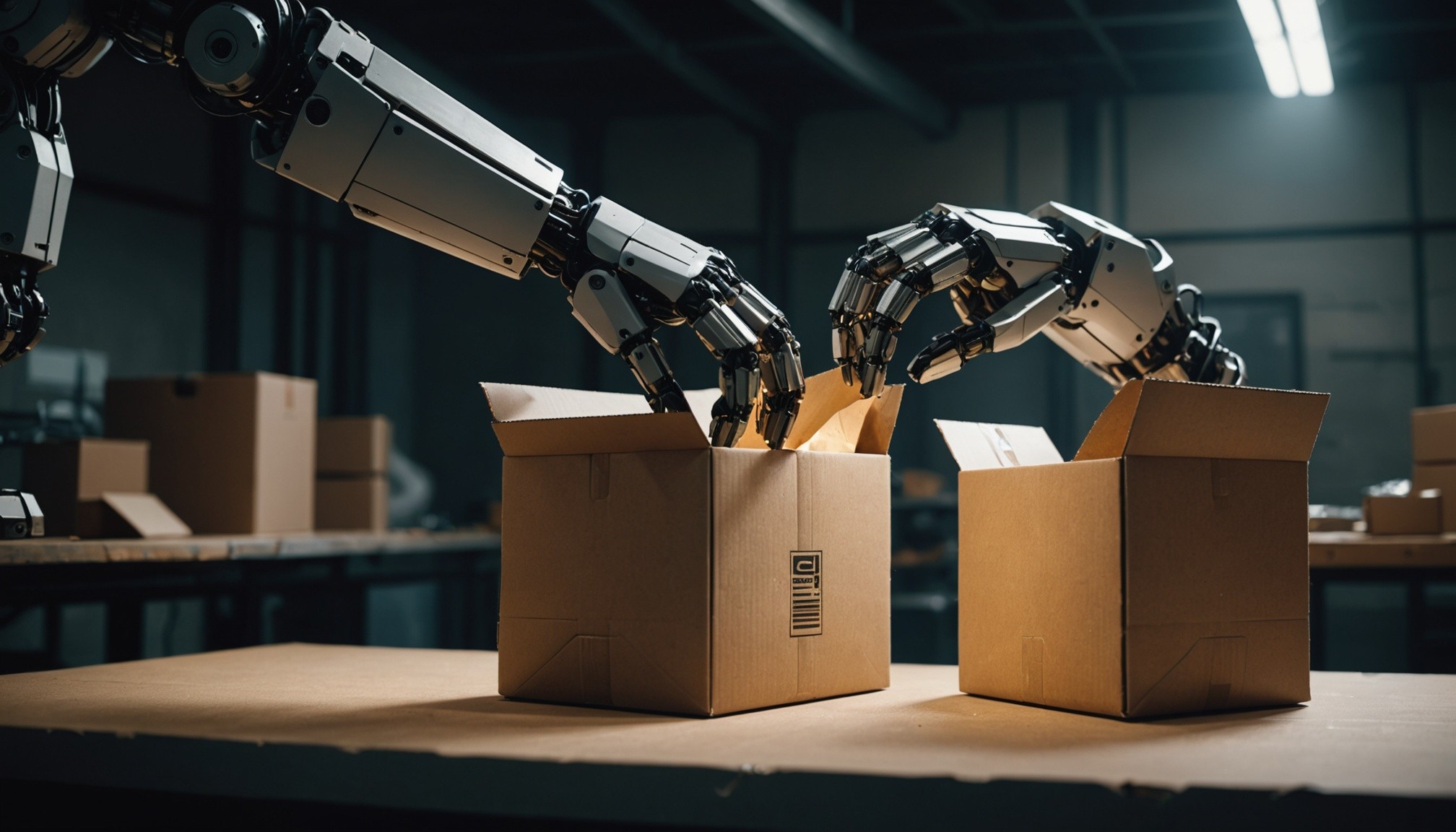
The same gloves are used on Genesis’ robots, enabling direct transfer of learned behaviours. According to CEO Zhou Xian, force data is the ‘unlock’ for effective manipulation. In demonstrations, a prototype robot successfully completed a multi-step packaging task—scanning boxes, folding flaps, taping, and labelling—though it occasionally fumbled, particularly with small adhesive labels. These ‘hiccup data’ moments are fed back into training, refining the model.
Simulation and physics-driven learning
Beyond real-world data, Genesis invests heavily in simulation. Adviser Minchen Li, co-author of an influential physics algorithm, helps the company generate millions of high-fidelity virtual experiences. These simulations model contact forces, friction, and material deformation, allowing the AI to encounter rare edge cases without physical wear.
Still, real hardware remains a bottleneck. The company’s flagship robot, Eno, has not yet been publicly demonstrated in action. While 30 to 40 units have been built, the dexterous hands degrade after only a few weeks of regular use, requiring replacement. Mass production is planned for next year via a U.S.-based contractor, with design finalised.
Why dexterity matters for business
For businesses, especially in logistics, manufacturing, and warehousing, reliable dexterity could unlock automation in tasks previously deemed too variable for robots. Current systems struggle with unstructured environments—handling irregular packages, inserting cables, or manipulating soft materials. Genesis’ focus on high-quality data and human-like hands aims to close this gap.
However, the path from lab to factory floor remains steep. Even with $500 million, scaling requires overcoming hardware durability, supply chain constraints, and the sheer complexity of generalised manipulation.
What it means
The investment signals strong belief in a data-first, vertically integrated model for robotics. For UK, UAE, and Kazakh firms exploring automation, Genesis’ approach suggests that success may depend less on novel AI architectures and more on control over data pipelines and hardware design. Dependence on a single supplier for both AI and robot hardware could simplify integration but increase vendor lock-in.
Khosla Ventures’ backing—also seen in its support for Mosaico, an Italian startup tackling robotics data infrastructure—highlights a strategic push to dominate not just AI chips, but the entire stack for embodied intelligence.
Genesis AI has not disclosed customer names or deployment timelines. For now, the robot remains a prototype. Yet its promise—that general-purpose robots are within reach through execution, not breakthroughs—resonates across the industry.